PLAIN-LANGUAGE REVIEWPotential benefits and concerns
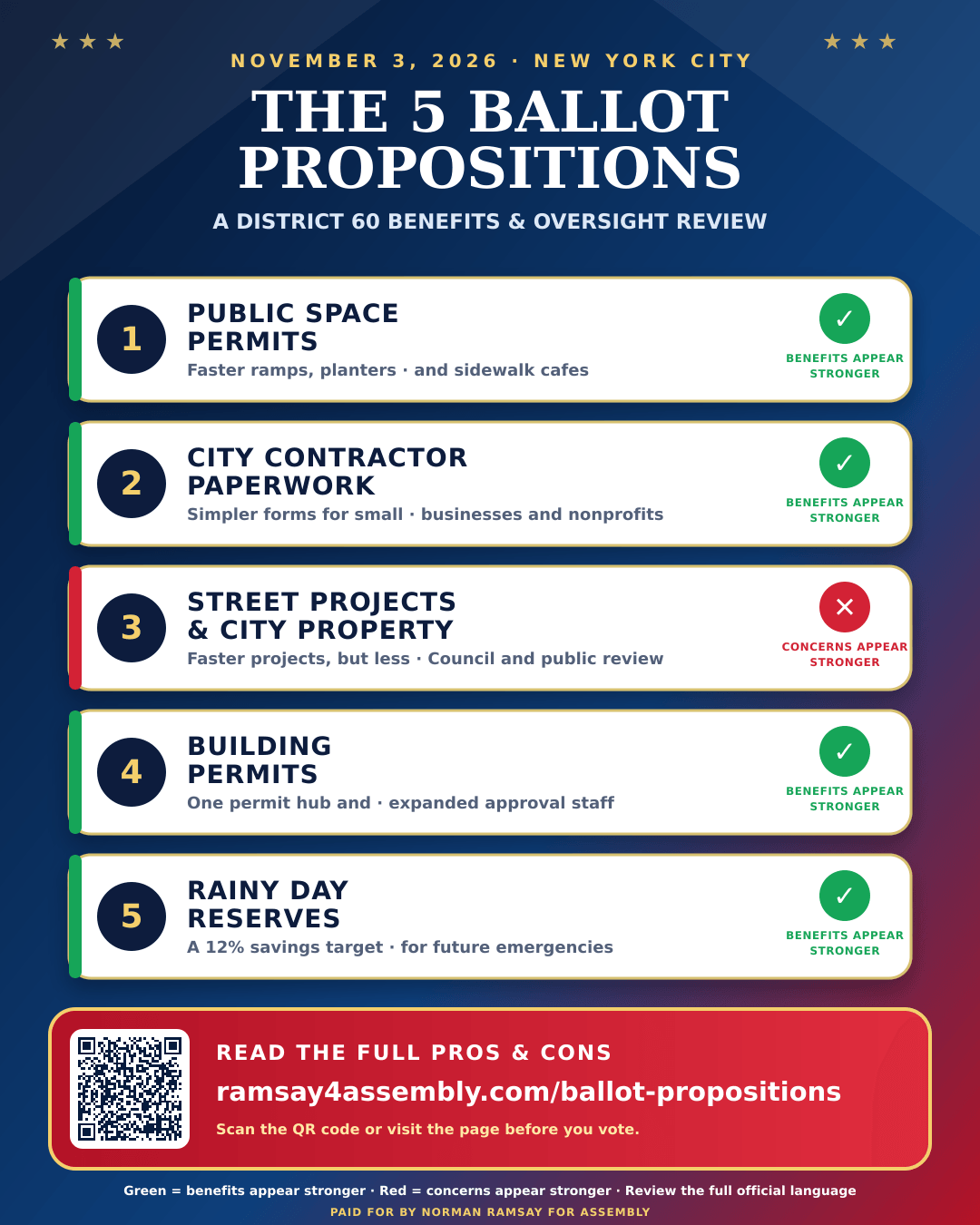
Each summary is based on the official ballot descriptions and the New York City Charter Revision Commission’s final report. The District 60 assessment focuses on small businesses, nonprofit services, public oversight, housing and building delays, neighborhood land-use power, and protection of essential services.
1
PROPOSITION 1
Speed Up Process for Granting a Revocable Consent to Use Public Space
✓ BENEFITS APPEAR STRONGER
This would make required public hearings optional for many ramps, planters, benches, sidewalk cafes, and other uses of public space. The City Council would no longer be able to reject sidewalk-cafe permits after Department of Transportation approval.
Potential benefits
- Could reduce delays and application costs for neighborhood restaurants and small businesses.
- Could speed approval of accessibility ramps, lifts, benches, and other useful streetscape improvements.
- Community Boards, Council members, and Borough Presidents would still receive notice and could comment.
Potential concerns
- Many applications could proceed without a mandatory public hearing.
- The City Council would lose its current authority to reject sidewalk-cafe permits.
- Residents would have fewer formal opportunities to challenge uses that affect sidewalk access, noise, sanitation, or parking.
District 60 assessment: Benefits appear stronger for District 60 because faster accessibility improvements and lower barriers for small businesses are valuable, but agencies must still take community objections seriously.
2
PROPOSITION 2
Reduce City Contractor Paperwork and Require Regular Procurement Policy Board Meetings
✓ BENEFITS APPEAR STRONGER
This would let the Procurement Policy Board simplify contractor questionnaires, require it to meet quarterly, remove a hearing requirement for certain service-contract plans, and permit delegation of some approvals for contracts over $5 million.
Potential benefits
- Could help smaller businesses and community nonprofits compete for City contracts without carrying the same paperwork burden as large vendors.
- Quarterly Procurement Policy Board meetings would create a regular public schedule for rulemaking and oversight.
- Faster contracting could help service providers begin work and receive payments sooner.
Potential concerns
- Removing hearings for certain client-service plans reduces one public oversight step.
- Delegating approvals for contracts over $5 million could concentrate decision-making within agencies.
- Simpler paperwork must not weaken background checks, performance review, or protections against favoritism.
District 60 assessment: Benefits appear stronger for District 60 because local nonprofits and small contractors often struggle with delays and paperwork. Approval should be paired with strong disclosure, auditing, and vendor-performance rules.
3
PROPOSITION 3
Speed Up Street Safety Projects, Disposition of Unused City Property, and Office Leasing
✕ CONCERNS APPEAR STRONGER
This broad proposal would change reviews for major street projects, allow expedited disposition of some City property without final City Council approval, and remove City Planning Commission and Council approvals from many City office leases.
Potential benefits
- Could allow urgent street-safety work to begin faster when supported by safety data.
- Could generate revenue or useful activity from small unused lots and certain development rights.
- Could reduce lengthy administrative delays when the City needs office space.
Potential concerns
- It combines three different policy areas into one yes-or-no question.
- Some public-property transactions could bypass the full land-use process and final City Council approval.
- Community Boards and local representatives would have less formal power over public land, office locations, and some transportation decisions.
District 60 assessment: Concerns appear stronger for District 60. Faster safety work is worthwhile, but public land and neighborhood planning decisions should not lose meaningful Council and community review through one bundled proposal.
4
PROPOSITION 4
Simplify Building Permitting and Move Waterfront Permitting to the Department of Buildings
✓ BENEFITS APPEAR STRONGER
This would authorize more Department of Buildings officials to approve construction documents, require a centralized permit system by 2030, and move certain waterfront-structure permits from Small Business Services to Buildings.
Potential benefits
- A single permitting hub could replace repeated submissions to multiple agencies and make project status easier to track.
- Additional authorized reviewers could reduce backlogs for housing, repairs, storefronts, and community facilities.
- A unified process may provide clearer accountability when applications stall.
Potential concerns
- Faster approvals must not reduce inspection quality, safety enforcement, or neighborhood protections.
- Moving waterfront work may lose specialized knowledge unless staff and expertise transfer with the responsibility.
- The centralized system is not required until 2030, so improvements may not be immediate.
District 60 assessment: Benefits appear stronger for District 60 because slow permitting raises costs and delays housing and repairs. The City should publish processing times and safety results so speed does not replace accountability.
This would establish a goal of holding at least 12% of the previous year’s City tax revenue in reserves and require a public method for calculating deposits, developed by the Office of Management and Budget with the Comptroller.
Potential benefits
- Stronger reserves could protect essential services, jobs, and vulnerable residents during recessions or emergencies.
- A published deposit method would make long-term savings policy more transparent.
- Deposits would still be approved through the normal City budget process and could be adjusted during hardship.
Potential concerns
- Money placed in reserves is unavailable for immediate housing, safety, infrastructure, and social-service needs.
- A 12% target could create pressure for service reductions or slower investments if pursued too quickly.
- Because deposits may be spread out or skipped during hardship, the proposal may not guarantee the stated reserve level.
District 60 assessment: Benefits appear stronger for District 60 because fiscal shocks often hurt working-class neighborhoods first. The reserve target should be reached gradually without cutting essential services or delaying urgent capital repairs.
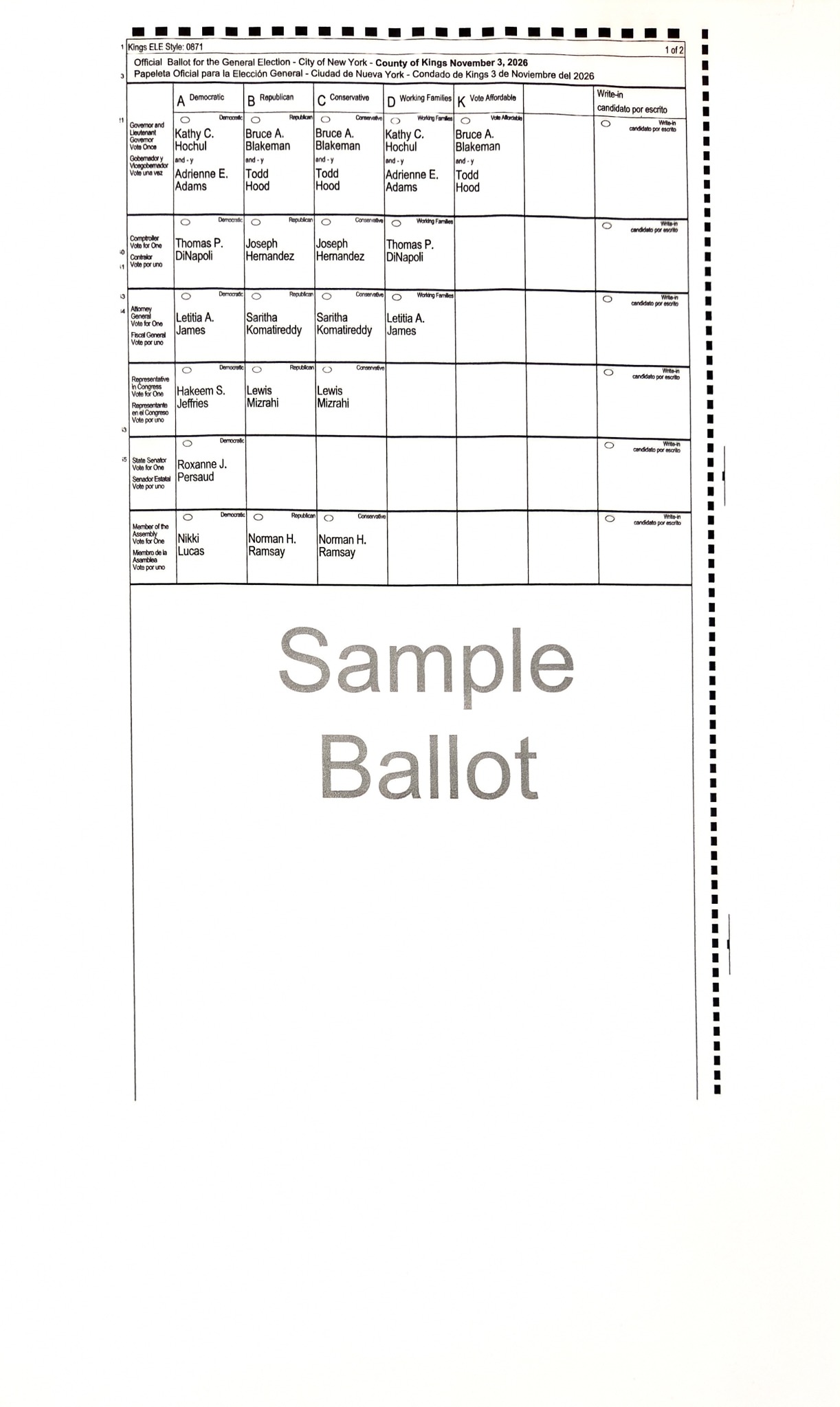 CLICK TO ENLARGE FRONT ↗
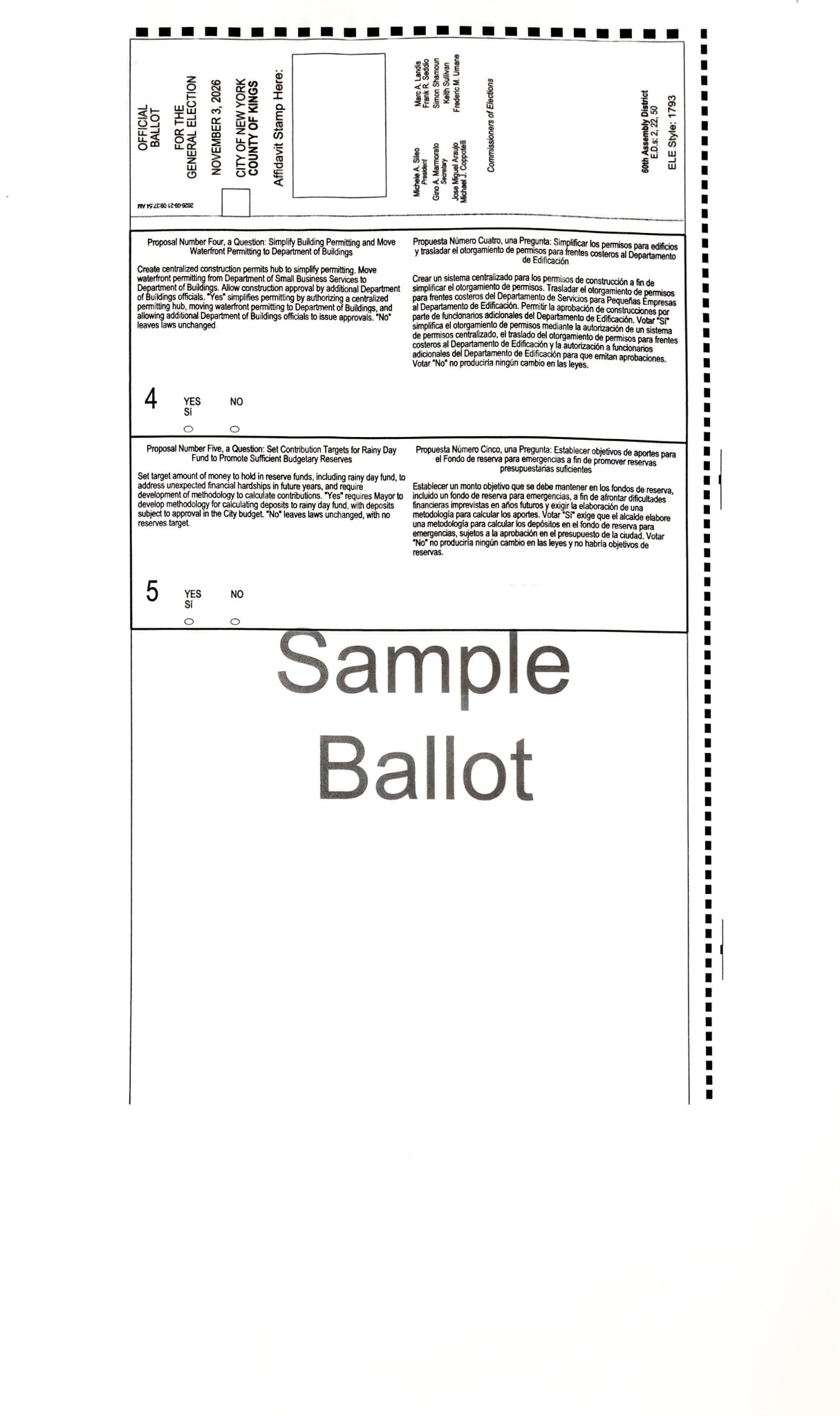 CLICK TO ENLARGE BACK ↗